


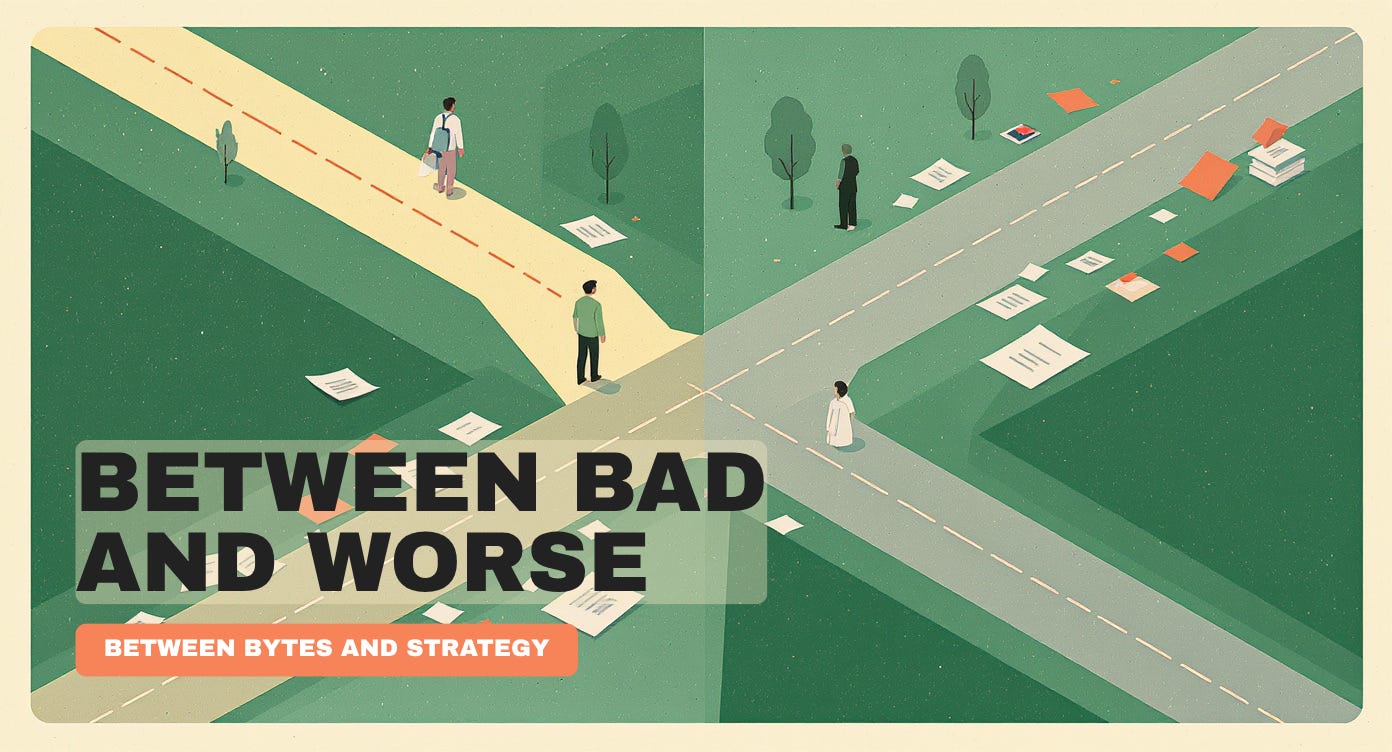
A former boss of mine had a line I carried around for years without quite knowing what to do with it: to manage is to make irrevocable decisions with insufficient information. I first heard it at the tail end of a tiring meeting, almost like a sigh out loud. It took me a while to understand he had compressed, into a single sentence, the core problem of any role that carries real authority.
There’s a category of decision that management vocabulary never names properly. It isn’t the one where a right answer and a wrong answer both exist, and the job is simply to tell them apart. It’s the one where every available path is bad, bad in different ways, and someone still has to choose, on a deadline, without waiting for more data to arrive. I call this a decision between two wrongs, on purpose, instead of “picking the lesser evil.” That phrase already carries a hidden assumption: that both options sit on the same scale, and the job is just to weigh which one is lighter. Every so often that’s true. Most hard decisions aren’t.
Isaiah Berlin, the political philosopher who spent much of his career asking why legitimate human values collide, had an uncomfortable argument about this. Freedom and equality, for instance, aren’t just hard to reconcile. Under certain arrangements, they’re incompatible. Gaining more of one means losing some other, and not because anyone did the math wrong. Because the two values were never on the same ruler to begin with.
No philosopher had a corporate investment committee in mind. But the problem he described keeps resurfacing in business clothing every time a leader has to decide where to put scarce capital under a ceiling of uncertainty that no amount of consulting can fully remove.
Take a committee debating where to invest in AI. At first glance it looks like a technical question. It isn’t. Waiting until there’s enough certainty costs competitive advantage, costs good people who leave for a more decisive rival, and costs an organization quietly learning, through its leadership’s hesitation, that stalling is the house style. Deciding too early on a technology whose maturity curve is still forming risks capital on a bet the field’s own evolution might make obsolete before any return shows up. Both sides carry a wrong. Neither is neutral. The real decision was never between getting it right and getting it wrong. It’s about which wrong the company is going to carry.
The same shape shows up far from technology. A company deciding whether to hire a strong candidate with ambiguous references faces the same pair of wrongs: hire too fast and inherit a culture problem that’s hard to reverse later, or wait for the ideal candidate and lose, somewhere along the way, the role to a faster-moving competitor and the operation to a leadership gap it can’t afford. A merger runs the same script: close the deal on incomplete due diligence because the pricing window is closing, or wait longer to audit and watch the seller take another offer. The domain changes. The structure of the issue doesn’t.
Here’s a quick test for telling whether you’re actually facing this kind of decision, rather than an ordinary hard decision dressed up as impossible. Ask: Is there some reasonable amount of additional information, arriving within a timeframe the decision can afford, that would change the choice? If yes, the issue is a data-collection problem, not a two-wrongs problem, and it’s worth waiting. If no, if more information would only shrink the margin of uncertainty without removing the pair of wrongs, you’re not looking at a hard decision. You’re looking at a decision between two wrongs, and what’s left isn’t more research. It’s deciding with what you already have.
Risk matrices, decision trees, scenario analysis, all of it genuinely helps. It organizes the information available, surfaces what was scattered, and forces whoever’s deciding to name the options instead of picking on impulse. But none of these tools decides for you. They set the table. Whoever sits down to eat is still the one carrying the wrong they chose, and no spreadsheet does that part for them. Mistaking the tool for the decision is a common way to postpone the discomfort of deciding, dressed up as methodological rigor that seems to relieve the decider of a responsibility that, in fact, never left their hands.
Asking for more data in that moment is tempting. Occasionally it’s the right call. But there’s a point where asking for one more study, one more pilot, one more quarter of observation stops being prudence and becomes an elegant way of pushing forward a discomfort that already belongs to the present. Irrevocability isn’t a flaw in the process. It’s the condition of it. Managing isn’t about eliminating uncertainty before acting. It’s acting despite it and answering for what comes after.
That should change how we judge the people who decide. Judging a leader purely by the outcome, without looking at the quality of the reasoning at the moment of choice, is as serious a lapse in judgment as any bad decision being judged. A good outcome born from a poorly reasoned decision doesn’t validate the method. A bad outcome born from a well-reasoned decision, given what was knowable at the time, doesn’t invalidate it. Most executive performance reviews blur these two planes together, and that’s precisely where they quietly fail.
None of this is an invitation to relativism, as if every decision under uncertainty were equally defensible just because certainty was never on the table. There’s a real discipline to deciding well between two wrongs, and the difference usually comes down to something simple: naming, plainly, which wrong you’re choosing, instead of hiding it behind the comfortable vocabulary of strategy. Available information is always insufficient. That’s not the excuse. That’s the starting point.
I held a CTO seat long enough to know this kind of decision shows up far more often than anyone warns you before the first time. It comes up almost weekly, folded inside choices that look purely technical or purely operational. I picked the wrong one a few times and the right one a few others, and the difference between those two experiences was never about regretting it afterward or pretending the wrong I’d chosen weighed less than it did. It was about carrying on with its actual weight on my back. That’s part of the job too.